


Key Takeaways
- Turvo is best suited to 3PLs and freight brokers that want transportation management, customer visibility, carrier collaboration, and integrations connected around the same shipment workflow.
- Infios Transportation Management, formerly MercuryGate TMS, is a stronger fit for larger 3PLs managing complex multimodal transportation networks that need advanced planning, optimization, freight audit, and settlement capabilities.
- McLeod PowerBroker is well suited to asset-based 3PLs and hybrid transportation businesses that need brokerage execution closely connected with dispatch, accounting, settlement, and carrier operations.
- Pick by the service you sell. A 3PL that brokers freight, one that runs warehouses, and one that owns tractors are buying three different products.
A customer emails asking where their load is. One person opens a tracking tab, someone else searches an email thread for the appointment time, and finance is still waiting on proof of delivery signed Tuesday. The information exists, but pulling it together takes time, slows customer responses, and holds up invoicing.
Those gaps matter when competing for business. The 2026 Third-Party Logistics Study found that 90% of shippers consider technology capabilities an important factor when choosing a 3PL, yet only 57% are satisfied with their providers’ capabilities.
The right 3PL logistics software should help your team deliver dependable service without increasing the cost of managing every load. Below, we compare three platforms, including Turvo, explaining who each suits, what pricing information is available, and which limitations matter before you commit.
1. Turvo: Best for 3PLs That Sell Visibility as Part of the Service
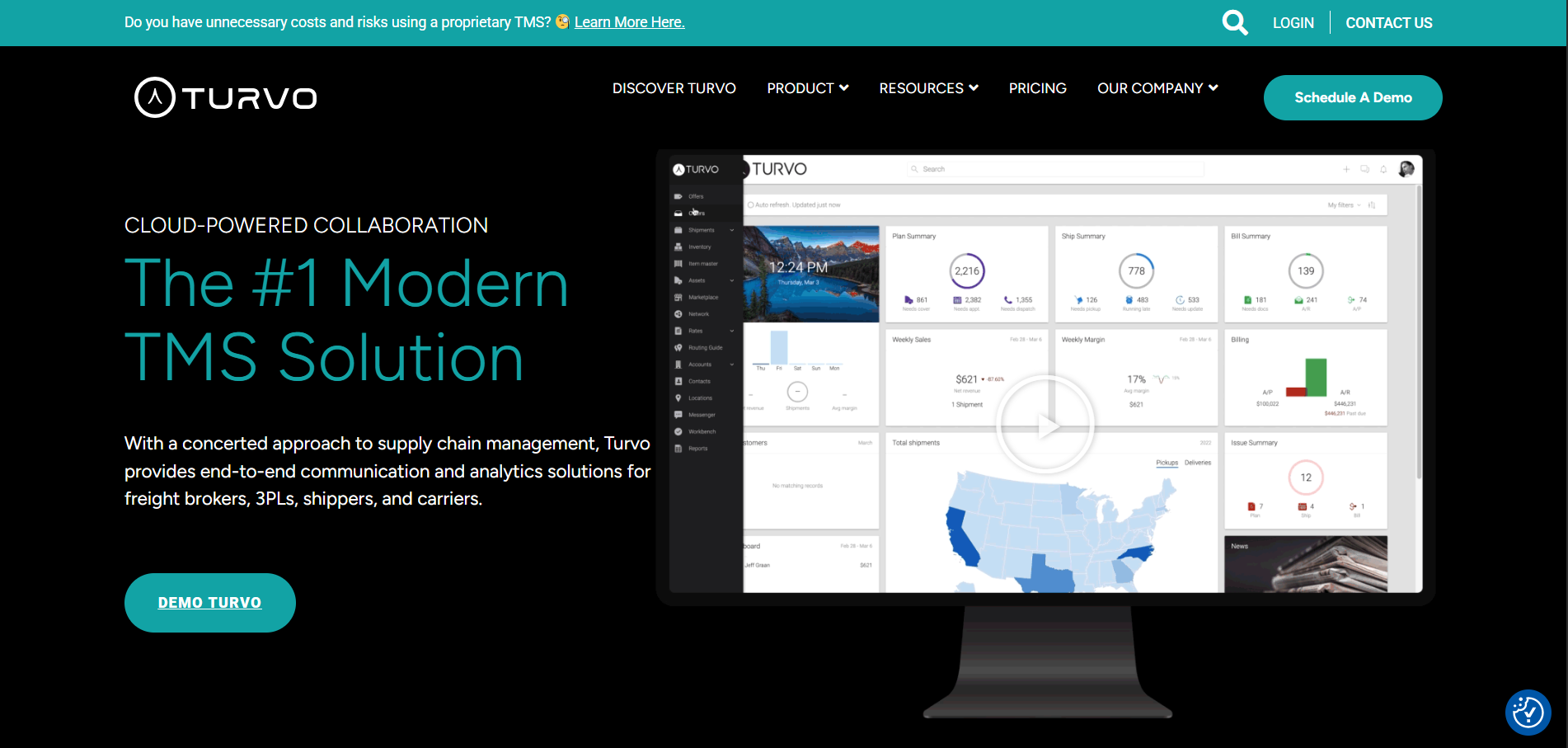
Turvo is a cloud-based transportation management system (TMS) and collaboration platform built for 3PLs and freight brokers that plan, execute, and settle freight for customers.
What separates it from a standard TMS is who gets to use it. Turvo extends shipment information, documents, and messages to the customer and the carrier, so everyone working a load sees the same thing. That makes the platform part of the service you sell.
Turvo’s Key Capabilities and Benefits
Turvo covers the freight lifecycle from order planning through settlement. What matters is what each capability buys a 3PL.
1. Order to Shipment Planning, So You Move More Freight Without Adding Headcount
More volume means more coordination, more documents, and more places for work to fall through. Hiring to absorb it is how 3PLs end up with revenue growth and flat margins.
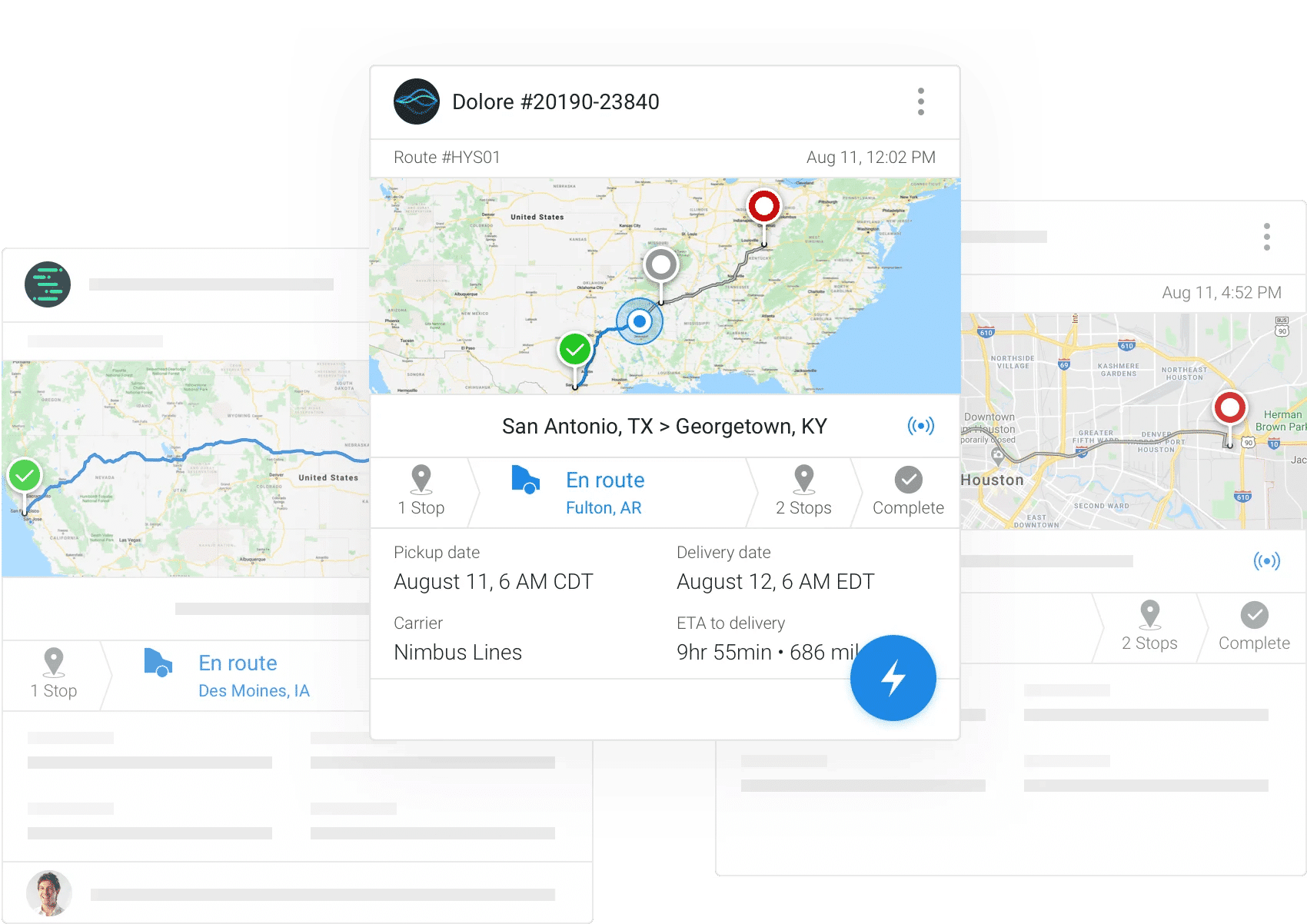
Order-to-shipment planning turns one or many orders into shipments in a single environment, covering routes, capacities, cost allocation, and multi-leg movements, then carries each through execution and settlement without handoffs.
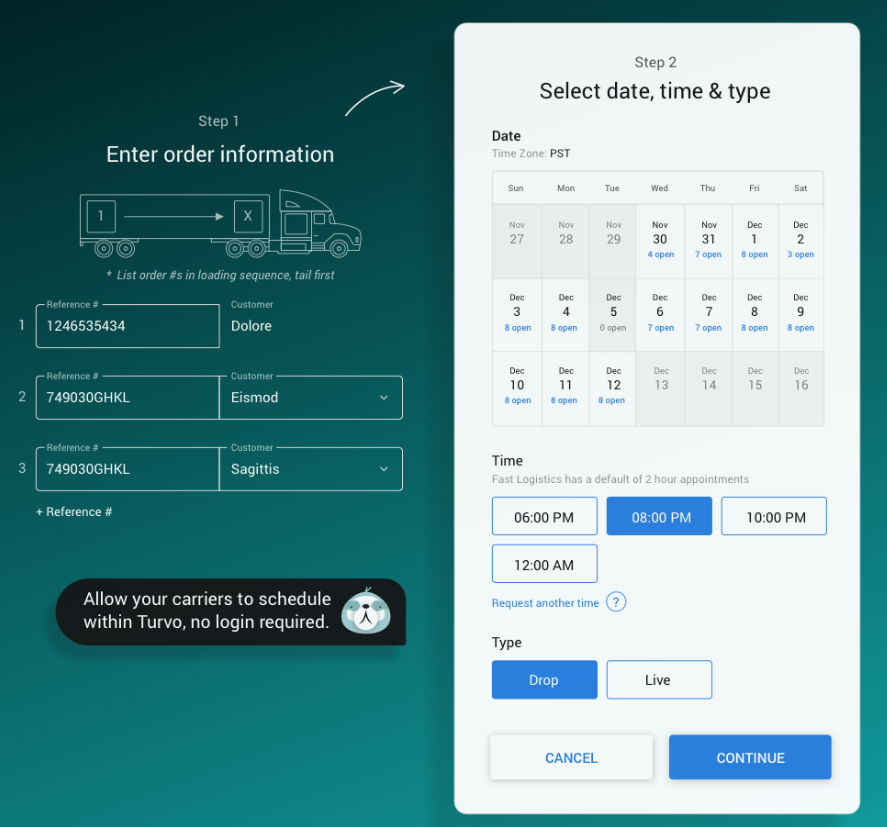
Appointment scheduling uses the same record so carriers book their own slots, and inventory visibility ties stock levels to planning for 3PLs holding goods.
The same team absorbs more freight, because fewer people re-key what the system already holds.
2. Collaboration Cloud, So Customers Stop Calling to Ask Where the Load Is
Most status work is not complicated. A customer asks where a load is, someone opens a tracking tab, a reply gets typed into email. Repeat that a few hundred times a week and it is a cost center.
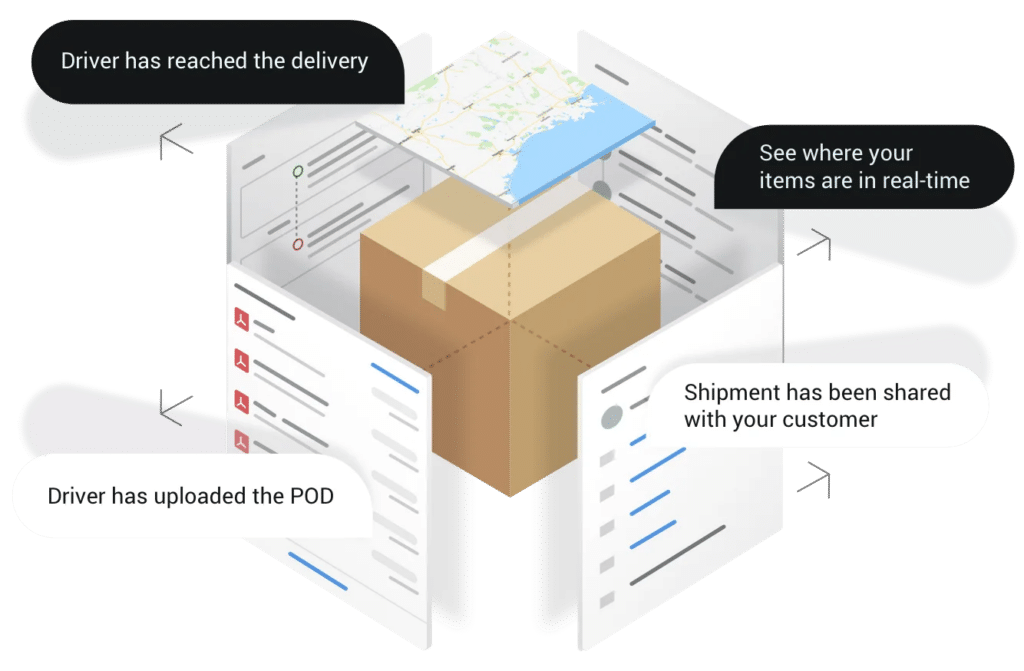
Turvo’s Collaboration Cloud invites customers, carriers, and partners into the shipment through shareable links, with messaging, documents, and alerts attached to the load rather than a separate inbox.
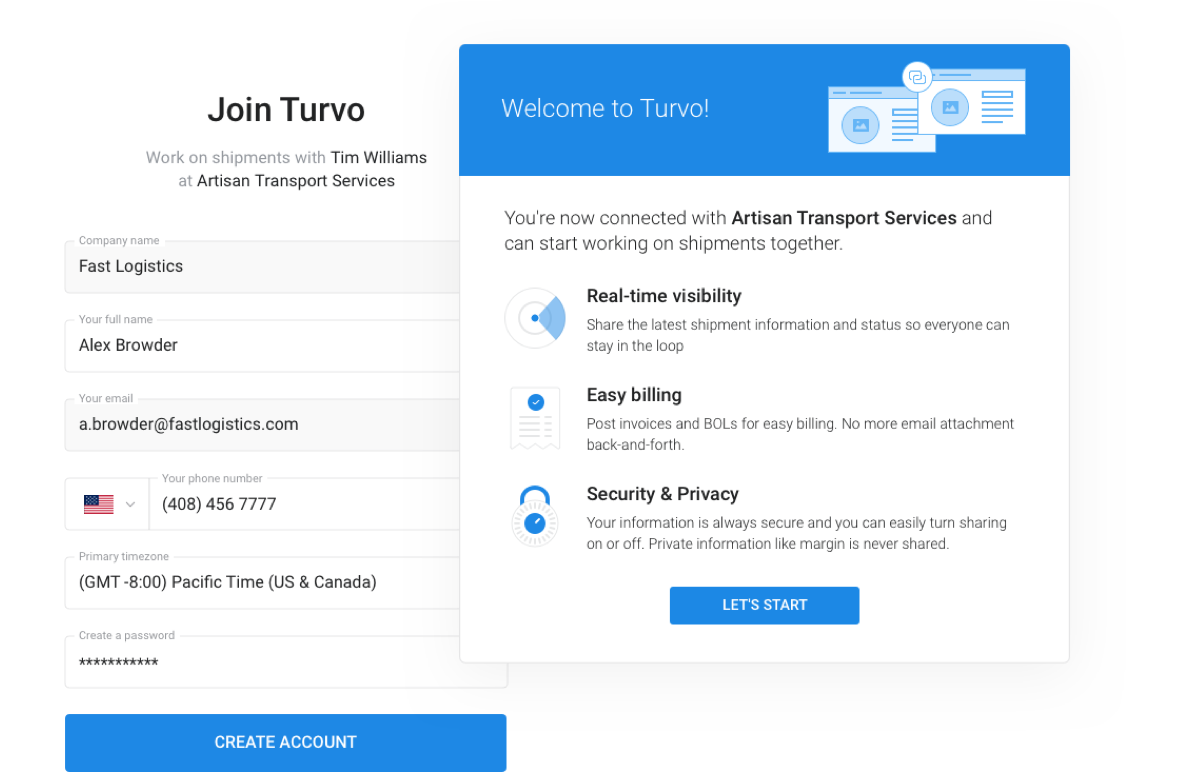
When something goes wrong, the people who need to act already have the context.

The Driver App, which the company says more than 1 million drivers use, feeds the same record with location updates and POD capture at the source.
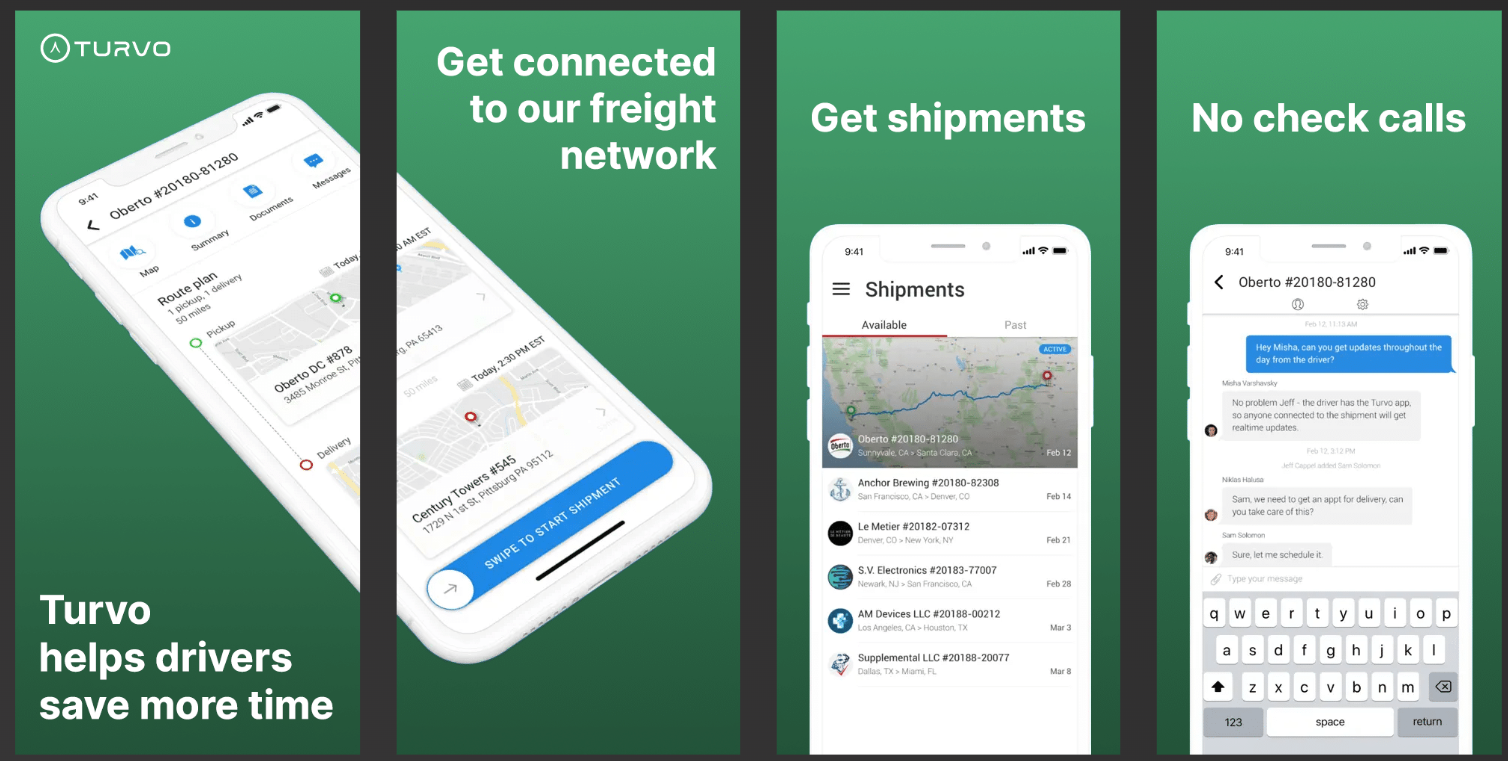
Customers notice this faster than any internal efficiency gain, and it cuts the check calls your team fields daily.
3. Integration Hub, So You Never Pay for a Second Migration
Most 3PLs do not want to replace their load boards, accounting system, or carrier vetting tools. They want them to stop living in separate windows.
Turvo’s Integration Hub uses pre-built connectors, a public API, webhooks, and data import tools to sit at the center of a wider stack. Current named connections cover the categories a 3PL leans on daily:
- Accounting and ERP: Oracle NetSuite and Microsoft Dynamics, so settlement data reaches finance without re-keying.
- Load boards and capacity: DAT and Parade, keeping carrier sourcing in the same workflow as execution.
- Visibility and tracking: project44 and FourKites, feeding status into the record your customer already watches.
- Carrier vetting and fraud screening: RMIS, MyCarrierPackets, and Highway, so compliance clears before a load is assigned.
You avoid a second migration. A 3PL adding a vertical, a mode, or a compliance requirement connects what it needs without replacing its system of record two years later.
Turvo Pricing
Turvo offers transparent pricing, with its TMS plan starting at $5,000 per month and Enterprise pricing available upon request. Both plans include onboarding and data migration, with additional support services available.
Where Turvo Shines
- Collaboration attached to the shipment: Messages, documents, and alerts sit on the load record, and shareable links bring customers and carriers into it.
- An experience both sides want to use: Operators get faster search and clearer statuses, and your shipper sees the same platform.
- Integration-first architecture: Public APIs, connectors, and webhooks keep the TMS as the operating core while other tools change around it.
- More freight without proportional overhead: Fewer manual touches per load, with analytics showing which customers and lanes carry margin.
- A migration path with support attached: Turvo Data Import moves customer accounts, carrier records, historical shipments, and loads in flight, and onboarding, training, and hypercare cover the weeks when workflows are still settling.
Turvo Customer Reviews
Robert Goldstein, CEO of Genpro, said: “We’re not just moving a load by truck from point A to point B. We’re able to identify new efficiencies and work more strategically with our clients.”
Brad Colvin, Director of Operations at Motus Freight, said, “With Turvo, we’re moving closer and closer to ‘the perfect shipment.’ We saw the impact of unifying our supply chain and using automation to simplify our business. We’ve cut 95% of the manual work out of each connected shipment. When we had to work from home because of COVID, nothing changed. We simply logged in from home without missing a beat. With the same headcount, we’ve been able to double our business.”
Who Turvo Is Best For
- 3PLs competing on service quality: Teams whose customers expect self-service visibility rather than emailed status reports.
- Growing 3PLs replacing a dated TMS: Operations needing integrations, usability, and room to scale without another migration.
- 3PLs with best-of-breed stacks: Teams keeping specialized load board, carrier, and accounting tools while the TMS stays the system of record.
Take the 3PL software overview for the full picture, or schedule a demo and walk a real load through it.
2. Infios TMS (Formerly MercuryGate) : Best for Large Multimodal Networks
Infios Transportation Management (TM), formerly MercuryGate TMS is a multimodal transportation management platform for shippers, 3PLs, brokers, and carriers, strongest in planning, execution, and freight settlement across modes. Körber Supply Chain Software completed the acquisition in 2024 and rebranded as Infios the following year, so you are evaluating a module of a larger suite rather than a standalone product.
Key Capabilities and Benefits
- Plan across every mode in one pass: Route and mode planning covers truckload, LTL, parcel, rail, ocean, and air.
- Recover money lost to invoice errors: Automated freight audit and payment catches billing discrepancies at scale.
- Run competitive procurement events: Freight bid tooling, rate benchmarking, and spot market access support structured carrier sourcing.
Pricing
Infios Transportation Management (formerly MercuryGate) does not publicly disclose pricing or standard plan tiers. Custom quotes depend on shipment volume, transportation modes, carrier requirements, and integrations.
Where MercuryGate Shines
- Genuine multimodal depth: Few platforms handle ocean, air, rail, parcel, and over-the-road planning with equal seriousness.
- Freight audit and settlement: Automated audit, carrier payment, and dispute management give finance control over freight spend.
- Configurability: Administrators reshape workflows without development work.
Where MercuryGate Falls Short
- Density over usability: Reviewers describe the interface as feature-dense and click-heavy, with a learning curve for occasional users.
- Implementation effort: Work outside native functionality adds services cost on top of a planned rollout.
- Not built around service delivery: Customer-facing collaboration is not its organizing idea.
Customer Reviews
A VP of Sales in the transportation industry said: “Overall our experience with the Infios TMS has been very positive. The platform is stable and delivers a consistently reliable operational environment.”
Robert K., a verified user on G2, said: “It’s a great way to communicate with customers about shipments.”
Who MercuryGate Is Best For
- Large multimodal 3PLs: Operations managing ocean, air, rail, and parcel alongside over-the-road freight.
- Freight-spend-intensive networks: Businesses where audit and procurement savings justify the implementation effort, including teams already on Infios warehousing systems.
3. McLeod PowerBroker: Best for Asset-Based 3PLs
PowerBroker is McLeod Software’s TMS for freight brokers and 3PLs, built alongside LoadMaster, its asset-based carrier product. Founded in 1985, McLeod serves more than 1,200 North American carriers, brokers, 3PLs, and private fleets.
If your 3PL runs trucks and a brokerage arm together, McLeod lets dispatch, carrier procurement, settlement, and accounting share one record. That is hard to assemble from separate products, and a legitimate reason to choose McLeod over a brokerage-only platform.
Key Capabilities and Benefits
- Run assets and brokerage off one ledger: Order management, carrier procurement, tracking, and accounting work together, with general ledger coding and direct bank interfacing.
- Automate carrier coverage with AI: An August 2026 integration connects an AI agent to PowerBroker’s digital freight matching, with CRST among the first customers live.
- Match loads digitally: Freight matching surfaces carriers from stored lane history, equipment type, insurance status, and past performance.
Pricing
McLeod does not publicly disclose standard pricing for PowerBroker. Custom quotes depend on operational requirements, user count, and selected add-ons or integrations.
Where McLeod PowerBroker Shines
- Financial depth: Ledger coding, settlement, and bank interfacing go further than most brokerage platforms attempt.
- Assets and brokerage in one place: Hybrid businesses avoid reconciling two systems and two versions of the truth.
- Maturity: Four decades of development mean trucking edge cases have usually been seen before.
Where McLeod PowerBroker Falls Short
- Interface age: PowerBroker only gained a browser interface in 2023, so teams switching for a modern experience should test the workflow closely.
- Weight for non-asset operations: A non-asset 3PL does not need the fleet depth that justifies the platform.
- No published pricing: Scoping through sales makes early budget comparison harder.
Customer Reviews
Maria A., a Logistics Coordinator, wrote, “You can keep your loads organized on the boards and keep them on track. Also, you can integrate it with any tracking tool.”
Olha N., an HR Manager, wrote, “With McLeod you can have all your data in one place. You don’t have to forward or share data between departments since it’s all there.”
Who McLeod PowerBroker Is Best For
- Asset-based 3PLs: Businesses that own trucks and broker freight from the same organization.
- Accounting-intensive, process-heavy brokerages: Teams where settlement and financial control sit at the center, with the resources for a longer implementation.
How We Ranked the Best 3PL Logistics Software
We compared these 3PL logistics platforms based on how well they support transportation operations, customer service, and business growth. Since non-asset 3PLs, asset-based providers, and multimodal operators have different requirements, we considered both operational capabilities and suitability for each business model.
- 3PL operating model fit: How well each platform supports different types of logistics providers, including freight brokers, non-asset 3PLs, asset-based businesses, and multimodal transportation networks.
- Transportation management capabilities: Coverage across order management, freight planning, carrier sourcing, dispatch, shipment tracking, document management, invoicing, and settlement.
- Customer and carrier collaboration: How effectively the software enables 3PLs to share shipment information, communicate with customers and carriers, exchange documents, and manage activities across organizations.
- Shipment visibility and exception management: The ability to monitor shipment progress, identify delays, automate alerts, and help teams respond to transportation disruptions.
- Integrations and connectivity: Compatibility with load boards, warehouse management systems, accounting platforms, ERPs, carrier networks, tracking providers, APIs, and EDI connections.
- Automation and operational efficiency: How effectively the platform reduces manual data entry, repetitive communication, document handling, and administrative work as shipment volumes increase.
- Implementation, scalability, and cost: The complexity of deployment, onboarding support, configuration requirements, pricing transparency, and ability to accommodate growing shipment volumes and operational needs.
How to Choose 3PL Logistics Software
The best 3PL software matches the service you actually sell. Shortlist on how a platform behaves inside your operation, not on boxes ticked.
1. Start With the Service You Actually Sell
A 3PL that brokers truckload freight, one that runs fulfillment centers, and one that owns tractors are three different buyers. 3PL transportation software and warehouse software solve different problems, and plenty of vendors blur that line. Write down your volume, modes, and customer count, then disqualify anything built for a different operating model, however strong the demo looks.
The fastest way to test fit is to watch someone run your own workflow. Schedule a demo and bring a lane that normally causes problems.
2. Test the Workflows That Eat the Most Time
Feature lists do not tell you where your team loses hours. Your exception workflow does.
Ask every vendor to run the ugly scenarios live: a load that misses its appointment, a carrier that has not uploaded a POD, an accessorial needing approval before billing. Count how many steps stay manual and how often the user leaves the system.
Turvo keeps messages, documents, alerts, and status on the shipment record, so exceptions get resolved where the freight is managed. Our guide to smoother 3PL operations covers that day to day.
3. Map the Integrations and the Customer Experience Before You Sign
List every system that must exchange data with the TMS: load boards, accounting, carrier vetting, telematics, your customers’ ERPs, and your WMS. Then push past “do you integrate with that?” Ask what data moves, which direction, and what needs custom development.
Check what your customers will see, too. A PDF report and an email thread means you compete on rate. Self-service tracking with shared documents and alerts means you compete on service.
Bring that list to the demo. Book a session and ask the hard version of every question above, starting with what happens when a customer wants an EDI connection you do not have yet. For more, see our guide to 3PL solutions and the checklist top 3PLs use to succeed.
Give Every 3PL Client One Shared View With Turvo
The 3PL market reached $323.4 billion in gross revenue in 2025 according to industry analysis published in 2026, and the providers taking share are the ones whose customers can see what is happening without asking.
If you move freight for customers and want those customers inside the workflow, that is what Turvo was built for. Schedule a demo to see it against your own workflows, or read why 3PLs choose Turvo first.
FAQs
1. Is 3PL logistics software the same as a warehouse management system?
No. Third-party logistics software is a broad label covering several categories. A 3PL TMS manages freight movement: planning, carrier sourcing, execution, and settlement. A warehouse management system manages inventory inside a facility. Many 3PLs run both and connect them.
2. Can one platform handle both transportation and warehousing for a 3PL?
Sometimes. Some 3PL management software covers both, usually with more depth on one side. A common approach pairs a TMS as the transportation system of record with a 3PL warehouse management system, so inventory status informs shipment planning.
3. How much does 3PL logistics software cost?
Pricing varies depending on shipment volume, transportation modes, and integration requirements. Turvo publishes a starting price of $5,000 per month for its TMS plan, while Infios and McLeod provide custom quotes upon request.
4. What should a 3PL ask vendors about data migration?
Ask which records move into the new 3PL software: customer accounts, carrier records, historical shipments, and loads in transit. Then ask who performs the work, how workflows get mapped, and what support continues after go-live.
5. Does 3PL software let customers track their own shipments?
Yes, on 3PL software built for it. Visibility ranges from a basic tracking portal to full participation in the shipment, with shared documents, messaging, and alerts. Shipper satisfaction with 3PL technology sits well below the importance placed on it, so that depth shows up at renewal.