


Key Takeaways
- Turvo stands out for 3PLs and managed transportation providers that need collaboration connected directly to freight execution, bringing customers, carriers, and the wider tech stack around each shipment.
- Infios Transportation Management (formerly MercuryGate) suits larger, multimodal 3PLs coordinating ocean, air, rail, parcel, and over-the-road freight, with the technical resources to configure it.
- McLeod Software fits providers running trucks alongside the brokerage, bringing dispatch, driver management, and general ledger accounting into one system.
- The rankings consider more than feature breadth, evaluating each platform on operating model fit, multi-client capability, integration flexibility, migration support, and honest limitations.
Your clients like working with you. They are less sure about the software you run their freight on.
The 2027 Third-Party Logistics Study found that 97% of shippers call their 3PL relationships successful, while only 70% are satisfied with their provider’s technology.”
The best 3PL software closes that gap: Turvo for customer-facing collaboration, Infios Transportation Management for multimodal optimization, and McLeod for asset-based operations. Here is where each one fits, and where each one does not.
What Is Third-Party Logistics (3PL) Software?
3PL software is the system a logistics service provider uses to plan, execute, and settle freight on behalf of its customers. Most 3PLs run a transportation management system at the center, then connect warehouse, accounting, visibility, and carrier tools around it.
A TMS handles the operational core: creating orders, planning them into shipments, sourcing and tendering carriers, tracking movement, collecting documents, and turning completed loads into invoices and carrier pay.
What separates 3PL software from a shipper TMS is the multi-client problem. You run freight for many customers at once, each with its own rates, service expectations, reporting cadence, and systems. The software has to keep those books separate while giving each customer a view into their own freight.
The practical benefits:
- Fewer manual touches per load, which lets the same team handle more volume
- Customer-facing visibility, so shippers stop calling for status updates
- Faster settlement, because documents and approvals sit with the shipment record
- Margin reporting by customer, lane, and carrier, so you know which accounts actually pay
- Integration with the rest of your stack, including WMS, ERP, accounting, and load boards
For a deeper look at how these pieces work together, see our guide to 3PL operations and collaboration and our breakdown of modern 3PL software.
1. Turvo: Best for 3PLs That Need a Customer-Facing Collaboration Platform
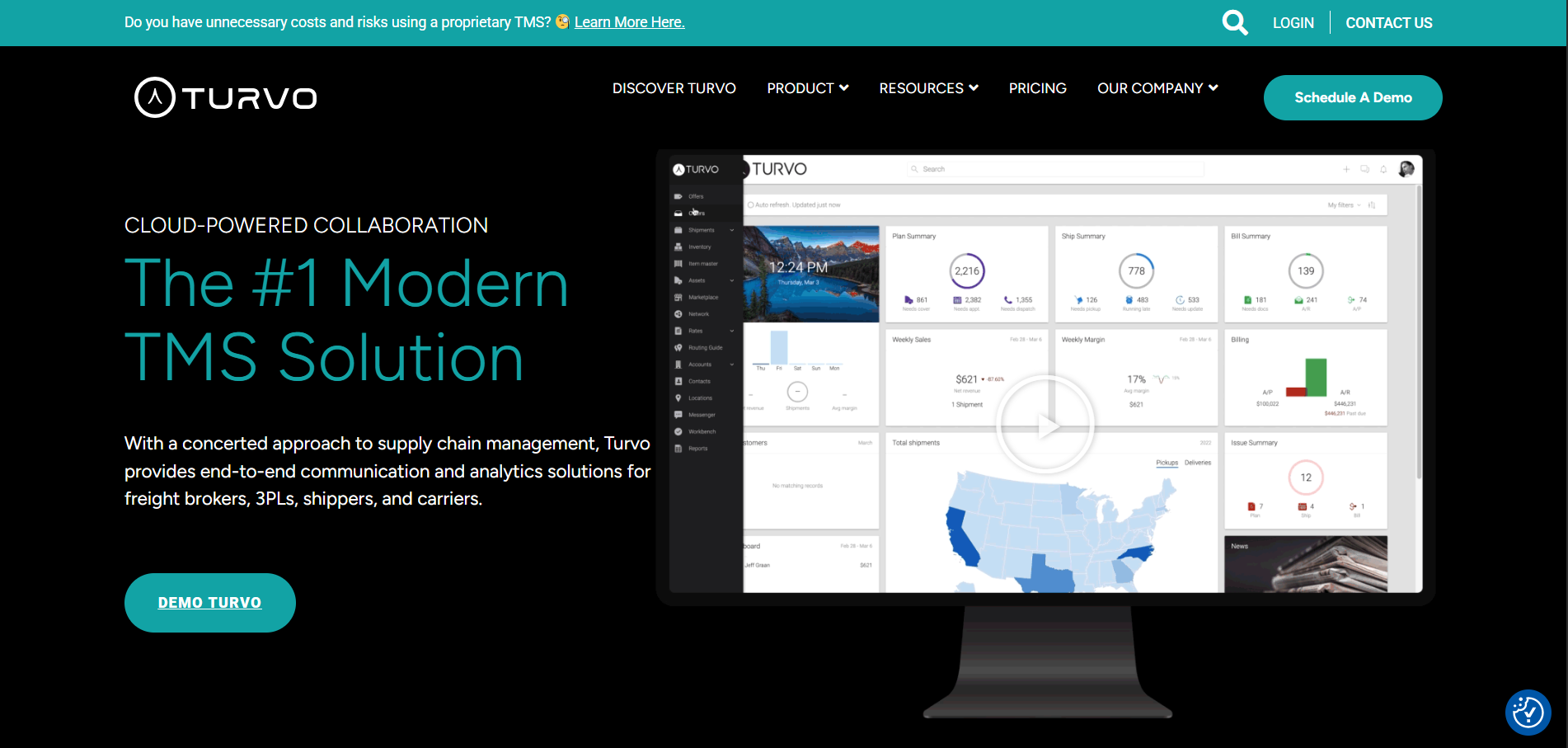
Turvo is a cloud-based transportation management system and collaboration platform built for 3PLs and freight brokers that manage freight for customers.
Most TMS platforms stop at the edge of your organization. Turvo extends past it. The Collaboration Cloud brings your customers, carriers, and partners into the context of the shipment itself, so a status question gets answered by the system rather than by a person on your team.
For a growing 3PL, that changes the economics. You take on more accounts without adding coordinators at the same rate, and your customers get a technology experience that makes renewal conversations easier.
Key Capabilities and Benefits
1. Handle More Volume Without Growing the Back Office at the Same Rate
Every new account brings freight and administrative work. More status updates, more document chasing, more rekeying between systems. Headcount usually scales with the second pile, not the first.
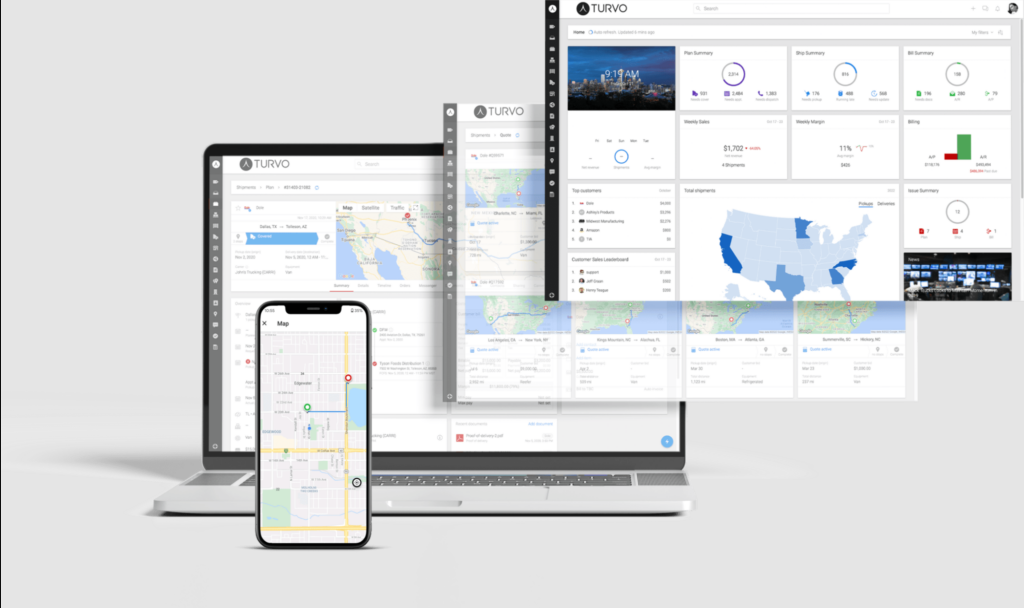
Turvo pulls planning, execution, settlement, communication, and shipment data into one operating environment. When a load delivers and the proof of delivery lands against the shipment record, the settlement step does not wait on someone to find an email.
Turvo reports that customers generate 3x more revenue per person and 5x more shipments per client, with 50% fewer manual updates. Those figures describe connected shipments on the platform, so treat them as directional for your own operation rather than a guaranteed outcome.
The result that matters: your team spends its day on customers and carriers instead of on data entry.
2. Give Customers a Self-Serve View That Makes Renewals Easier
Your customer experiences your technology whether you intend it or not. If the only way to answer “where is my freight” is a phone call to your team, you are the interface, and you are a slow one.
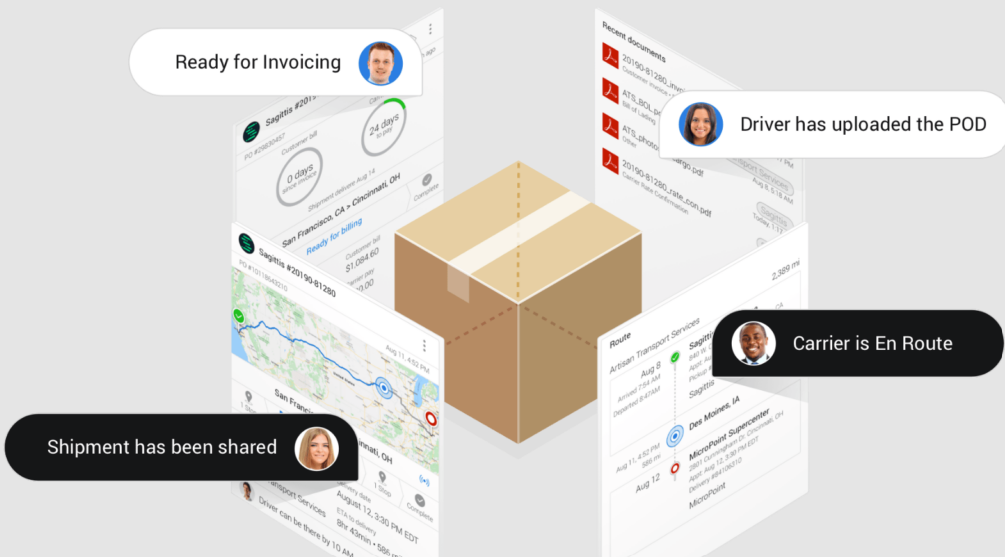
Turvo’s collaboration layer lets you invite a customer into the shipment with shared visibility, documents, alerts, and messages attached to the load. They self-serve. Your coordinators stop fielding check calls.
This is also where visibility earns its keep. A location on a map answers one question. Pairing that location with the documents, the exception, and the right person to resolve it answers the question your customer actually has.
Pro tip: Before a demo ends, ask the vendor to log in as one of your customers. If they show you the internal view instead, the customer-facing experience is thinner than the pitch suggests.
3. Keep the TMS at the Center of a Best-of-Breed Stack
3PLs rarely run one system. You have a WMS, an accounting platform, load boards, carrier vetting tools, and visibility providers, and you will add more as customers ask for more.
Turvo’s Integration Hub supports pre-built connectors, public APIs, webhooks, and data import tools, with named integrations including Oracle NetSuite, Microsoft Dynamics, DAT, project44, Parade, RMIS, MyCarrierPackets, Highway, and FourKites.
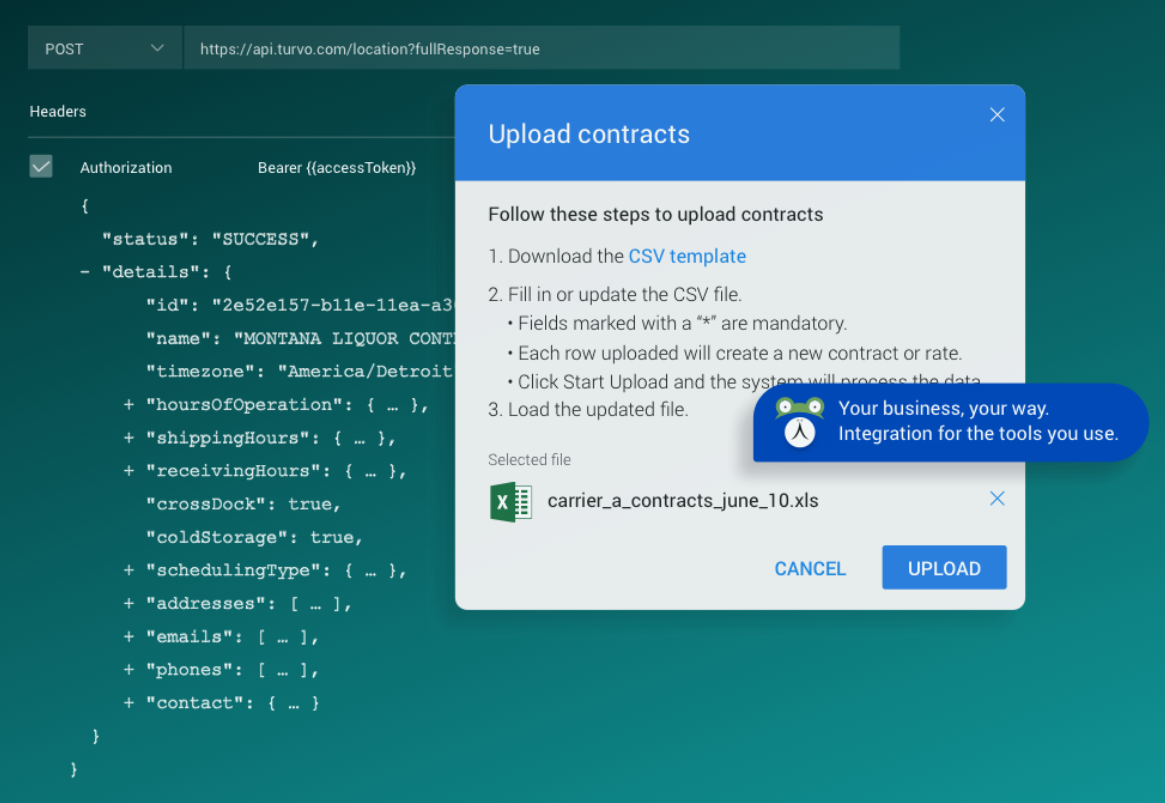
Around that core, order to shipment planning, inventory and warehouse visibility, appointment scheduling, and analytics cover the workflows a multi-client 3PL runs daily. The Driver App brings status and document capture closer to the truck.
The business case is avoiding a second migration. A platform that connects to what you already run is a platform you will not replace in three years.
Turvo Pricing
Turvo offers transparent pricing, with its TMS plan starting at $5,000 per month and Enterprise pricing available upon request. Both plans include onboarding and data migration.
Where Turvo Shines
- Collaboration connected to freight execution: Customers, carriers, and partners work from the same shipment record your team does, so visibility turns into action instead of another portal login.
- A modern interface for staff and customers: The system your coordinators sit in all day is the one your customers see, which affects adoption, training time, workarounds, and how current your brokerage looks.
- Integration-first architecture: Public APIs, pre-built connectors, webhooks, and data import tools let Turvo act as the system of record inside a best-of-breed stack rather than demanding every capability live in one application.
- Scale without matching overhead: Removing repeated status checks, rekeying, and disconnected handoffs lets a team support more shipment volume without a matching rise in operational overhead.
- Visibility connected to action: Location sits alongside documents, alerts, exceptions, and contextual messaging, so teams manage by exception instead of checking every load.
- Support across the full lifecycle: Implementation, onboarding, hypercare after go-live, training resources, and ongoing support are treated as part of the product rather than an upsell.
- Migration handled as a process: Turvo Data Import moves customer accounts, carrier records, historical shipments, and in-flight loads, with implementation running in line with industry norms.
- Product direction informed by the industry: Workflows and terminology come from people with transportation experience and from direct customer feedback, which shows up in how closely the software matches real brokerage work.
- Published entry pricing: A stated starting point moves budget conversations faster than a quote-only process.
Turvo Customer Reviews
Jordan Barrett, Director of IT at Zengistics, said: “Turvo is often discussed as an operating system.” He credits real-time margin reporting by customer, account representative, and carrier with enabling faster decisions on profit and loss.
Chris Sommerville, Senior VP of Customer Experience at Port City Logistics, said Turvo “was the only platform that met all those qualifications” after evaluating options for user experience, integration capability, customer and carrier collaboration, and built-in visibility.
Kareena B., Logistics Coordinator, wrote on G2 that “tracking is the best feature I have ever seen,” pointing to real-time shipment monitoring and fast generation of bills of lading and rate confirmations.
Who Turvo Is Best For
- Managed transportation providers: Teams running freight programs for enterprise customers who expect a portal, reporting, and self-service visibility as table stakes.
- Growing 3PLs adding accounts faster than headcount: Operations where the constraint is coordinator capacity rather than carrier capacity.
- 3PLs with brokerage-style operations: Providers that plan, execute, and settle freight for customers and need margin visibility by account.
- Providers replacing a dated TMS: Teams whose current system cannot integrate well or cannot show customers anything.
- 3PLs building a best-of-breed stack: Operations that want the TMS as the operating core while keeping specialized WMS, accounting, and carrier tools.
See how the platform fits your day-to-day operation. Book a demo now.
2. Infios Transportation Management: Best for Multimodal 3PLs With Technical Resources
Infios Transportation Management connects transportation planning, execution, and settlement across ocean, air, rail, parcel, and over-the-road freight for shippers, 3PLs, brokers, and carriers.
The platform sold as MercuryGate until Körber Supply Chain Software acquired it in 2024. After Körber’s 2025 rebrand to Infios, it carries the Infios name. Older comparisons still say MercuryGate, so ask vendors to scope against the current product.
Key Capabilities and Benefits
- Optimize freight across every mode you touch: Multimodal planning spans ocean, air, rail, parcel, and over-the-road, which matters when a single customer program crosses modes.
- Reduce transportation spend through optimization: The multimodal optimization engine balances cost, service, and capacity, and reviewers consistently name it the platform’s strongest component.
- Configure the system to your operating model: Deep configurability lets larger 3PLs match existing workflows rather than adopting a vendor’s defaults.
- Close the loop on freight settlement: Freight audit and pay capability connects execution to financial reconciliation.
Pricing
Infios does not publicly disclose its pricing. Custom quotes are provided based on selected modules, shipment volume, and configuration requirements.
Where Infios Transportation Management Shines
- Multimodal depth: It covers a wider range of transportation modes in one system than either alternative here.
- Optimization capability: Route planning and cost efficiency are the strengths reviewers return to most often.
- Enterprise configurability: Large 3PLs with established workflows can shape the platform around them.
Where Infios Transportation Management Falls Short
- Learning curve and interface age: Reviewers describe a system that rewards experienced users and frustrates new ones. Onboarding takes longer than with lighter platforms.
- Support consistency: Responsiveness is the most common complaint across review sites.
- Implementation and customization cost: Configuration depth comes with services cost, and several reviewers flag that customizing the platform is expensive.
Customer Reviews
Elyse R., a reviewer in logistics and supply chain at a company of 51 to 200 employees, wrote on Software Advice in June 2024 that the platform “provides good flow and information between internal departments,” with shipment details readily available on the home screen.
A VP of Sales at a transportation company with $50M to $1B in revenue, reviewing on Gartner Peer Insights in June 2026, rated the platform 4 out of 5 and said support “quite often is inconsistent in responsiveness and depth of assistance.” The same reviewer called the optimization engine the platform’s best component.
Who Infios Transportation Management Is Best For
- Large multimodal 3PLs: Providers managing ocean, air, rail, and parcel alongside truckload freight.
- 3PLs with in-house technical teams: Organizations that can staff configuration and integration work.
- Optimization-driven operations: Teams where routing and consolidation savings justify implementation effort.
3. McLeod Software: Best for 3PLs Operating Trucks Alongside Brokerage
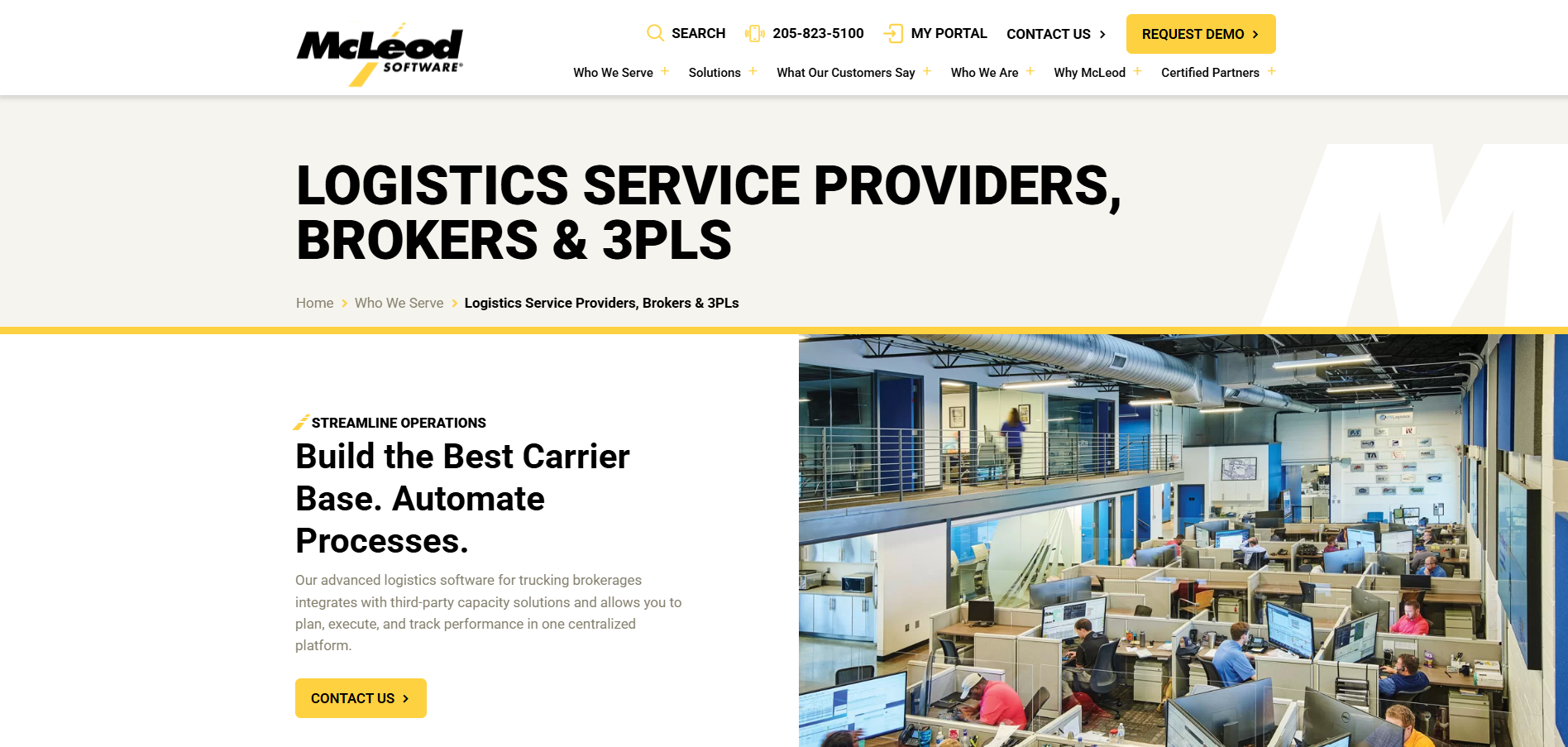
McLeod Software connects dispatch, load execution, driver management, and full accounting in one system for brokerages, 3PLs, and asset-based carriers.
The company has built transportation software since 1985. PowerBroker serves brokerage and 3PL operations, LoadMaster serves asset-based carriers, and the two share a code lineage.
That matters for one specific kind of 3PL: the provider running its own trucks and a brokerage at the same time, a combination neither alternative here matches.
Key Capabilities and Benefits
- Run assets and brokered freight in one system: PowerBroker and LoadMaster share lineage, so 3PLs with a fleet and a brokerage can operate both without a second platform.
- Close the books without exporting: A general ledger and full accounts package covering balance sheet, income, and cash flow sit inside the TMS rather than in a connected accounting tool.
- Hold invoices until documents clear: Rendition Billing waits on document rules before an invoice goes out, which protects settlement accuracy.
- Connect the rest of the stack: McLeod currently says 260+ off-the-shelf, fully tested integrations backed by 140+ Certified Partners.
Pricing
McLeod does not publicly disclose pricing for its software solutions. Pricing is customized based on the selected products, user count, and deployment requirements.
Where McLeod Shines
- Financial depth: Built-in general ledger accounting is a real advantage for 3PLs that want operations and finance in one system.
- Asset and driver management: Driver workflows, compliance, and equipment management are native rather than bolted on.
Where McLeod Falls Short
- Interface age and training load: Reviewers consistently cite a dated interface and a steep learning curve. If your argument for switching is a modern experience for your team and your customers, test this closely.
- Implementation timeline: Full deployments are measured in months, not weeks, which is a longer runway than cloud-native alternatives.
- Customer-facing experience: The platform’s depth points inward at operations and finance rather than outward at the shipper portal experience.
Customer Reviews
A verified LoadMaster reviewer on G2 wrote that the platform “has a very extensive database and integrates well with other software.”
Bryan A., Team Leader, said, “What I like most about LoadMaster is how it simplifies shipment management and provides excellent track-and-trace visibility. It gives me a clear view of every shipment throughout its journey, making it easy to monitor progress, respond quickly to delays, and keep customers informed. The centralized dashboard, real-time updates, and efficient workflow help streamline daily logistics operations and reduce manual effort. Overall, it’s a reliable platform that improves productivity and makes managing shipments much more efficient.”
Who McLeod Is Best For
- Asset-based 3PLs: Providers running owned equipment and drivers alongside brokered freight.
- Finance-led operations: Teams that want general ledger accounting inside the TMS.
- Established providers with training capacity: Organizations that can absorb a longer onboarding curve in exchange for depth.
How We Evaluated These 3PL Software Platforms
We assessed each platform against the criteria that decide whether a 3PL can grow on it, rather than against feature counts.
- Operating model fit: How well the platform matches asset-light brokerage, managed transportation, multimodal, or asset-based operations.
- Multi-client capability: Whether the system separates customer books, rates, and reporting cleanly.
- Customer-facing experience: What your shippers can see and do without calling your team.
- Integration flexibility: Breadth of connectors, API access, and how easily the stack changes later.
- Workflow coverage: Order planning, carrier sourcing, execution, documents, settlement, and analytics.
- Migration and support: Data migration, onboarding, training, and what happens after go-live.
- Honest limitations: Where each platform is the wrong answer, stated plainly.
How We Evaluated the Best 3PL Software
We assessed each platform based on the factors that determine whether a 3PL can handle more customers and freight without creating the same increase in operational overhead.
- Operating model fit: Suitability for asset-light brokerage, managed transportation, multimodal logistics, asset-based operations, or hybrid models.
- Multi-client capability: Ability to keep customer rates, workflows, reporting, and shipment information separate while managing them in one environment.
- Workflow efficiency: Coverage across order planning, carrier sourcing, shipment execution, documents, settlement, and analytics.
- Customer-facing experience: What shippers can view, access, and complete without relying on manual updates from the 3PL team.
- Integration flexibility: Breadth of connectors, APIs, and options for linking WMS, ERP, accounting, carrier, visibility, and other logistics systems.
- Migration and support: Data migration, onboarding, training, implementation assistance, and support after go-live.
- Operational limitations: Where each platform may require additional systems, technical resources, training, or process changes.
How to Choose the Right 3PL Software
Start with how your operation actually runs, then test the software against it. These five checks surface the trade-offs that matter.
1. Match the Platform to Your Operating Model
An asset-light 3PL moving truckload freight for 30 customers needs something different from a provider running ocean and air alongside a private fleet.
Write down your volume, modes, customer count, team structure, current systems, and the complexity you expect in two years. Asset-based operations pull toward McLeod. Multimodal and global freight pulls toward Infios.
If your growth depends on winning and keeping customers who expect a technology experience, that pulls toward Turvo, where the collaboration layer is the product rather than an add-on.
2. Pressure-Test the Workflows That Eat the Most Time
Feature lists do not predict daily friction. Pick the three workflows that consume the most hours in your operation and make every vendor run them live.
Common candidates: onboarding a new customer with its own rate structure, handling a detention claim, chasing a missing proof of delivery, and moving a delivered load into settlement.
Pro tip: Give every vendor the same three workflows and the same sample load. Scripted demos hide friction. Identical tasks make platforms comparable.
Count the clicks. Count how many times the user leaves the system. Ask what happens when the workflow goes sideways, because that is most of the job.
3. Map the Integrations Before You Sign
List every system that must exchange data with the TMS: WMS, ERP, accounting, load boards, carrier vetting, telematics, and visibility providers.
Then go past “do you integrate with this.” Ask what data moves, whether it flows both ways, what needs custom development, and what adding the next tool costs.
4. Check What Your Customers Will See
Your shippers are consolidating providers. Technology satisfaction is one of the criteria they use, and most of them will judge yours through whatever portal or link you hand them.
During demos, open the customer view. Can a shipper find their load, see the documents, and get an answer without emailing you? Can they do it on a phone?
5. Plan the Migration Before You Commit
Switching a TMS touches active shipments, customer and carrier records, integrations, user roles, and finance workflows. Treat it as a project, not a software purchase.
Ask what data moves, who owns each step, how workflows get mapped, what training users receive, and what support looks like after go-live.
Did you know: Shipments already in flight are the hardest part of a TMS migration. Ask specifically how in-transit loads carry across, not just historical records.
Turvo uses Turvo Data Import (TDI), a spreadsheet-based mechanism for moving customer accounts, carrier accounts, historical shipments, and shipments already in flight.
Connect All Stakeholders in the Supply Chain with Turvo
Shippers are consolidating their 3PL partners and rating provider technology lower than provider service. The providers who keep those accounts will be the ones whose software gives customers something worth logging into.
Turvo connects your team, your customers, and your carriers around shared transportation workflows, so your coordinators spend less time answering status questions and your shippers spend less time asking them. Open APIs keep the specialized tools you already run connected to the TMS as your operation grows.
If you are evaluating a platform that has to serve both your operations team and your customers, request a Turvo demo and see how it handles your workflows.
FAQs
1. Is 3PL Software the Same as a TMS?
Not exactly. A TMS is the transportation core of a 3PL’s software stack. Full 3PL software may also include warehouse management, customer portals, accounting, and visibility tools layered around that core.
2. How Much Does 3PL Software Cost?
3PL software pricing varies depending on the provider, features, shipment volume, and implementation requirements. Some providers, like Turvo, publish starting prices, while others offer customized quotes based on business needs.
3. Do 3PLs Need Separate Warehouse and Transportation Software?
Usually yes. Most 3PLs run a dedicated WMS for warehouse operations and a TMS for freight, then integrate the two.
4. How Long Does 3PL Software Implementation Take?
Third-party logistics (3PL) software and WMS (Warehouse Management System) implementation typically takes 2 to 16 weeks, though enterprise-grade or multi-site setups can span 6 to 12+ months.
5. Can 3PL Software Handle Multiple Customers With Different Rates?
Yes. Multi-client support is a defining requirement for 3PL software. Each customer needs its own rate structure, service rules, reporting, and visibility, kept separate from every other account.